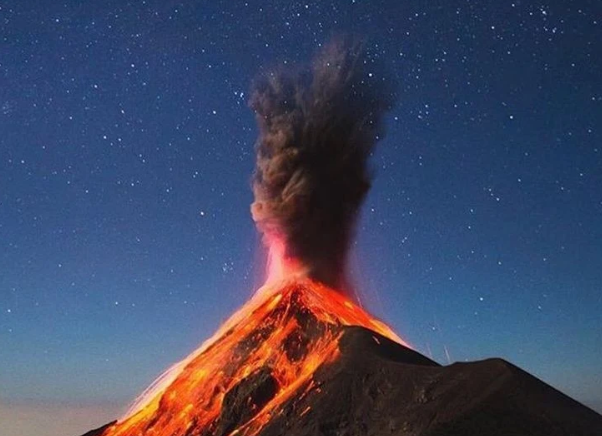

Guatemala City — Guatemala’s disaster management agency raised the country’s emergency alert to orange — its second-highest level — on Monday after Fuego, Central America’s most active volcano, entered a fresh eruptive phase that sent ash and lava spewing for miles around.
The eruption began early Monday and grew stronger through the day. By nightfall, the volcano was throwing up plumes of ash roughly six kilometers into the sky, according to Guatemala’s Institute of Volcanology, while lava crept down its slopes. Authorities say ash has already started falling on nearby towns.
Fuego sits about 35 kilometers southwest of Guatemala City. As the activity intensified, the national disaster coordination agency, Conred, ordered the evacuation of two villages closest to the volcano and shut down a highway that links the country’s south to the colonial city of Antigua, a UNESCO World Heritage site. Schools in the surrounding area were also told to suspend classes for the day.
Officials are urging residents in the region to stay away from ravines, where fast-moving volcanic debris tends to funnel, and to have emergency kits ready in case evacuation orders expand.
A volcano with a history of sudden escalation
Fuego rarely stays quiet for long. Guatemala sits on the Pacific “Ring of Fire,” a zone of intense seismic and volcanic activity that stretches around much of the Pacific basin, and Fuego alone has forced evacuations several times in recent years — including a scare last year that displaced more than 500 people and another in 2023 that moved around 1,200 residents out of harm’s way.
The volcano’s most devastating eruption came in 2018, when fast-moving flows of lava and hot gas swept down toward the town of San Miguel Los Lotes with little warning, killing over 200 people and leaving a similar number missing. That disaster reshaped how seriously Guatemalan authorities treat Fuego’s warning signs — evacuations now come faster and cover a wider radius than they once did.
For now, officials say Monday’s eruption remains below that worst-case scenario, but they’re not taking chances: the orange alert stays in place until volcanologists see activity settle back down.
This report draws on statements from Guatemala’s Conred disaster agency, the Institute of Volcanology (INSIVUMEH), and wire reporting from AFP.